What's Inside
- The 90-Second Booth Window and the Spec Card That Saves It
- Show Specials Versus Itemized Quotes for Multi-Day Weddings
- Testing a Vendor's Fluency in Halal, Modesty, and Segregation
- When to Negotiate on the Exhibition Floor
- Tariq and Amina's 48-Hour Brochure Audit
A Muslim bridal expo compresses months of vendor research into a single afternoon. That compression works in a couple's favor only when they arrive with a system. Without one, the day becomes a blur of glossy flyers, scanned badges, and promotional pricing that rarely survives contact with a real Nikah and Walima timeline. Preparation, itemized pricing, and specific questions about religious requirements help couples make better use of booth conversations and follow-up emails.
The 90-Second Booth Window and the Spec Card That Saves It
During the afternoon rush, a high-traffic vendor booth may have roughly 60 to 90 seconds with each passing couple before the aisle backs up behind them.
Ninety seconds is enough time to judge creative fit. It is far too little time to recite a guest count, spell an email address, and explain why the Walima falls two days after the Nikah. Couples who spend the window on logistics leave without ever learning whether the florist understands their aesthetic or the caterer has served a 400-guest hall before.
Tablet sign-ups can be a time sink. Couples who type their details into vendor tablets at every stop can lose just about 15 minutes in a single aisle. Two printed tools avoid repeated manual entry: a 3x5-inch specification card and a sheet of pre-printed address labels that vendors can peel and stick onto their own lead forms.
What the 3x5 Card Must Carry
- Estimated guest count, split by family side: vendors price staffing and seating differently for 220 on the groom's side and 180 on the bride's than for a flat 400.
- Target wedding month, so the vendor can flag Ramadan proximity or peak-season premiums immediately.
- Venue type: banquet hall, masjid community hall, hotel ballroom, or outdoor tent.
- Multi-day religious requirements, written plainly, for example "Nikah on Friday, Walima on Sunday."
One further step belongs 24 to 48 hours before the show. Set up a dedicated wedding email address and a shared cloud folder. Booth QR codes trigger automated follow-ups and promo codes almost instantly, and isolating them keeps a personal inbox usable while preserving every discount code in one searchable place.
Show Specials Versus Itemized Quotes for Multi-Day Weddings
The economics of the booth explain the flyer. Exhibition booth rental, pipe-and-drape setup, and weekend staffing can cost vendors between $1,500 and $4,500 per event. Recovering that outlay requires volume, so vendors print standardized "show special" packages built for quick bookings.
Those packages may quote a single-day, 5-hour consecutive block for 150 to 200 guests. For many South Asian and Arab Muslim families, that template describes almost nothing about the actual event. The line items that drive real cost are absent: 400-plus guest counts, dual-stage setups for gender-segregated halls, and split-day Mehndi and Walima timelines that require two load-ins and two teardowns.
Generic Flyer Versus Custom Proposal
Placed side by side, the two documents diverge sharply. The generic flyer offers one stage, one room, one 5-hour block, and a headline price. A custom itemized proposal for the same couple accounts for a Friday Nikah, a Sunday Walima, room dividers and a second stage for the women's hall, separate staffing for each day, and a 72-hour written price lock that holds the promotional tier while the full scope is costed. The headline number on the flyer is a starting reference at best.
Date Holds and Price Locks Compared
The booth will often propose a "date hold." This may mean a non-refundable flat fee of $500 to $1,000, paid on the spot, against no itemized scope. Rather than paying a floor deposit against a one-page expo intake form, request a 72-hour written price lock while the vendor prepares a full multi-day service agreement. The lock preserves the show rate; the hold surrenders leverage before a single deliverable is defined.
Keep Your Deposit Pocketed
Any payment requested before an itemized proposal exists should be declined politely. Ask for the promotional rate in writing, with an expiry date, and review written contract terms and cancellation policies before committing funds.
Cooling-off periods, deposit refundability, and contract enforceability differ from one local jurisdiction to the next. A rule that protects a couple in one state may not exist in another.
Testing a Vendor's Fluency in Halal, Modesty, and Segregation
Many vendors at a Muslim bridal expo will say yes to halal food and segregated seating. Yes costs nothing at a booth. Rather than relying on yes-or-no availability questions, ask for evidence of operational separation and privacy protocols, presented right at the booth or within days of the show.
Catering: Paperwork Over Promises
A caterer with genuine Islamic event experience can produce current wholesaler invoices, dated within the past 30 to 60 days, confirming a hand-slaughtered zabiha supply chain. Beyond sourcing, ask about dedicated prep surfaces that prevent cross-contamination and whether the kitchen operates a zero-alcohol policy, including in sauces and desserts. Hesitation on any of these points tells a couple more than a polished tasting plate.
Photography and Videography for Segregated Halls

For a gender-segregated reception, the women's side may need a 3-to-4-person all-female camera and crane crew. Ask the studio to name who would staff it, rather than simply confirming it is possible. Privacy handling matters equally: ask the studio to describe an offline editing protocol using encrypted local hard drives, with no raw footage passing through public cloud links.
Modest Bridal Styling
Makeup artists and stylists who regularly serve hijabi brides may schedule a 45-to-60-minute buffer in a private suite for structural pinning and high-neck gown steaming before first-look photography. A stylist who has never budgeted that window may run late on the day itself.
Three Proofs Worth Demanding
Anchor every cultural vetting conversation to three concrete items: recent zabiha supplier invoices, an offline hard-drive editing rider covering women's hall footage, and your own 3x5 specification card handed over during the booth window. Vendors who engage seriously with all three have usually done this work before.
When to Negotiate on the Exhibition Floor
The first 120 minutes, give or take, after doors open can be poorly suited to negotiation. This is peak lead-capture time, and temporary booth staff are typically instructed to hand out brochures and scan badges. Couples who attempt custom package swaps in this window may be deferred to post-show emails.
The final 45 to 60 minutes can be different. As aisle traffic drops, lead floral designers, executive chefs, and studio owners may become available for 10-to-15-minute conversations. These are the people who can actually approve a change.
A practical floor plan follows from this: browse and collect during the opening hours, hand over spec cards in the afternoon rush, and return to shortlisted booths at the end of the day for substantive discussion.
Value-Adds That Outperform Cash Discounts
Labor-heavy packages leave vendors little room for cash reductions, yet operational extras often cost them far less than their retail value. Requests that tend to land well include:
- A 2-hour complimentary engagement shoot from the photography studio
- Upgraded head-table floral risers from the decorator
- 60 minutes of overtime coverage for Walima speeches that run long
Ask for Hours, Not Dollars
Walima programs with family speeches and duas regularly overrun. Securing an extra hour of coverage in writing at the expo can save more than a modest percentage discount would.
Tariq and Amina's 48-Hour Brochure Audit
The following example follows a fictional couple, Tariq and Amina, who left a Sunday expo with 14 vendor brochures. Their follow-up runs on three timed checkpoints within 48 hours, designed to turn floor notes into contract riders before show pricing expires.
Step 1 (Monday, 9:00 AM): Three-Pile Triage
Roughly 18 hours after the expo, they spread all 14 brochures on the dining table and sort them into three piles. Six generic mass-market flyers, with no mention of segregated halls or multi-day events, go straight into recycling. Five secondary options are scanned into a "Backups" subfolder in their wedding cloud drive. The remaining contenders become the shortlist, capped at three per service category.
Step 2 (Monday, 2:00 PM): The Four-Sentence Follow-Up
From their dedicated wedding inbox, they send each shortlisted vendor a short email that references one specific booth detail. Their message to the decorator reads:
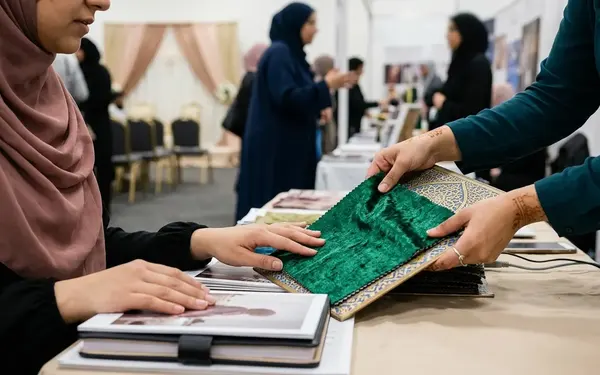
"Assalamu alaikum, we spoke with you at your booth on Sunday afternoon about the green velvet Nikah partition for our Friday ceremony. We would like to hold the show rate you quoted under a 72-hour written price lock while you prepare an itemized proposal. Our attached spec card covers 400 guests, a Sunday Walima, and a dual-stage segregated hall. Are you available for a 30-minute video consultation on Tuesday?"
The named detail reminds the vendor exactly who they are, and the request shifts the relationship from booth lead to formal consultation.
Step 3 (Tuesday, 6:00 PM to 8:00 PM): Contract Against Flyer
After Tuesday's consultations, revised contracts arrive. Tariq and Amina place each one beside the original booth flyer and check three items line by line: the price matches the locked show tier, a zabiha certificate rider is written into the catering agreement, and the photography contract names an all-female camera crew for the women's hall along with offline hard-drive editing. The caterer's draft omits the zabiha rider, so Amina replies asking for it to be added as a numbered clause. Only once all three items appear in writing does Tariq wire the retainer, at 7:45 PM, inside the 48-hour window.