From Early Arabian Contracts to Modern Multicultural Halls
In 7th-century Arabia, marriage functioned primarily as a tribal negotiation. Families cemented alliances by paying a marriage gift directly to the bride's father or tribal patriarch. Early Islamic jurisprudence dismantled that custom through Medinan legal reforms. The law redirected the dower (Sadaq or Mahr) directly to the bride as her personal, inalienable asset, mandated her explicit verbal consent to validate the marriage covenant (Nikah), and required two adult witnesses for the contract to hold legal weight.
Alongside the signed contract stood a second pillar: the Walima. Hosted within one to three days following the signing or consummation of the Nikah, this public banquet announced the union to the community and established hospitality as a religious duty.
As Islam spread across South Asia, the Levant, North Africa, and Southeast Asia, communities layered intense regional pageantry over those two foundational acts. Consider two Saturday afternoon celebrations happening in the same city. At a Palestinian-American wedding, guests link shoulders in a fast-paced Dabke line dance behind a drum corps escorting the couple into a hotel ballroom. Across town, a Pakistani-British ceremony features a groom arriving in embroidered sherwani tailoring while cousins playfully block the doorway to negotiate a cash toll before the contract signing. The music, garments, and pre-wedding festivities look completely distinct, yet both events anchor their timelines to the same Islamic marriage rites.
For a first-time non-Muslim guest, separating universal religious rites from regional family customs removes all guesswork from the day. Once you know whether you are walking into the legal covenant, the community feast, or both, you can read any invitation with quiet confidence.
Reading the Invitation and Dressing for the Venue
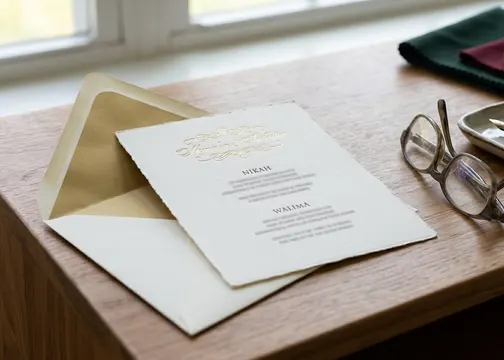
Heavy cream cotton paper, embossed gold calligraphy at the top, and two separate times or locations printed below: Muslim wedding invitations frequently list the Nikah and the Walima as distinct segments. The Nikah is the formal religious marriage ceremony, often scheduled earlier in the day at a mosque or a quiet hall. The Walima is the reception feast hosted after the marriage is solemnized.
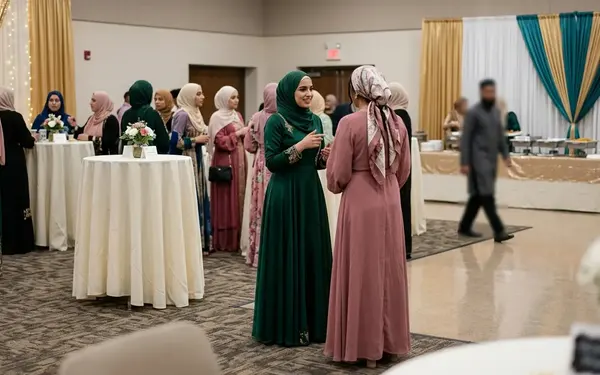
Modest bridal fashion and guest etiquette start with coverage that moves comfortably with your body. Women should select outfits where hemlines reach the ankle bone and sleeves extend to the wrist, paired with high necklines that require no adjustment when leaning forward. Men should wear full-length trousers and collared shirts or suits; trousers must cover from the navel to below the kneecap even when seated cross-legged on prayer carpets. Note that strict floor-seating and headscarf protocols govern ceremonies inside a mosque prayer hall, whereas hotel ballroom Walima receptions frequently feature mixed-gender round tables where women wear uncovered hair and formal evening gowns.
Mosque Ceremony Logistics
- Arrival buffer: Arrive 15 to 20 minutes prior to the printed Nikah start time. You will need those minutes to navigate shoe rack storage in the vestibule and locate the correct gender-partitioned entrance.
- Footwear preparation: Because all shoes come off at the prayer hall threshold, wear clean, intact dress socks or opaque hosiery.
- Headscarf selection for women: Seasoned guests pass over a standard silk or satin Pashmina shawl in favor of a lightweight jersey or crinkle-cotton wrap secured with two magnetic pins. Slippery luxury fabrics slide off the crown of the head every few minutes during floor seating, whereas textured cotton stays put without piercing delicate blouse fabrics.
Mosque Vestibule Protocol: Pack your headscarf and magnetic pins in an accessible outer pocket of your handbag so you can drape your wrap in the foyer before stepping past the shoe racks.
Pronouncing Traditional Greetings: Assalamu Alaikum and Barakallahu Lakuma
Stepping into the foyer or approaching the elevated bridal stage (the Kousha) brings your first direct interaction with the couple's elders. Using traditional Arabic greetings immediately bridges cultural distance, and family members warmly welcome non-Muslim guests who share these words.
When meeting parents, grandparents, and ushers at the entrance, open with the universal greeting: "Assalamu alaikum" (Peace be upon you). If an elder greets you first with this phrase, reply with "Wa alaikum assalam" (And upon you be peace).
When you reach the bride and groom, a receiving line interaction at the Kousha typically lasts around 30 to 45 seconds per guest group. For high-volume receptions where a long line waits behind you, the one-word congratulation "Mabrook" (Congratulations) or the two-word phrase "Nikah Mubarak" (Blessed Marriage) delivers immediate warmth. If the moment is unhurried, offering the full prophetic wedding blessing leaves a lasting impression. Practice this phonetic breakdown before you arrive:
"Ba-ra-kal-la-hu la-ku-ma wa ba-ra-ka a-lai-ku-ma wa ja-ma-a bai-na-ku-ma fee khair."
(May God bless you both, shower His blessings upon you, and join you together in goodness.)
Navigating Cross-Gender Handshakes
Physical greeting norms vary across households and levels of religious observance. Many practicing Muslims do not shake hands or hug members of the opposite sex outside their immediate family. At the receiving line, experienced non-Muslim guests monitor the posture of the opposite-gender host. Wait for a bride, groom, or relative of the opposite sex to extend a hand first. When a hand is not extended, place your right palm flat over the center of your chest while giving a slight, warm bow of the head. This gesture communicates deep respect without crossing religious boundaries around physical touch.
What Happens During the Nikah Recitation and Contract Signing
The formal Nikah ceremony runs roughly 20 to 40 minutes, transforming the couple's status through a structured legal and spiritual sequence. Behind the scenes, before the public sermon begins, the officiant (an Imam or Qadi) verifies the identity of the bride's representative (the Wali) and two official adult witnesses. The officiant also confirms that the agreed-upon Mahr—the mandatory bridal gift from the groom to the bride—is properly recorded in the marriage ledger.
Once the assembly is seated, the ceremony unfolds in four clear steps:
- Opening Quranic Recitation: The officiant or a designated reciter chants verses from the Quran in Arabic, frequently featuring Surah Ar-Rum, verse 21, which reflects on tranquility, love, and mercy between spouses.
- The Marriage Sermon (Khutbah): The Imam delivers an address reminding the couple of their mutual rights, responsibilities, and accountability to God and each other.
- Proposal and Acceptance (Ijab and Qubul): The legal heart of the Nikah. The couple is invited to speak the formal proposal and acceptance. The verbal contract requires three consecutive repetitions of "Qabiltu" (I accept) or a single clear affirmation in the local language in front of the officiant and the two official witnesses.
- Signing the Register and Collective Dua: The bride, groom, witnesses, and family elders sign the marriage ledger while guests look on.
To close the ceremony, the Imam leads a collective supplication (Dua). Muslim guests will raise their palms upward at chest level and say "Ameen" at the end of the prayer. As a non-Muslim guest, you do not need to mimic the hand gesture if it feels unfamiliar; remaining seated, quiet, and attentive until the officiant lowers his hands is completely welcomed and appreciated.
Navigating Prayer Breaks, Photography Etiquette, and the Halal Feast
Islam structures the day around five solar-calculated prayer windows (Salah), and afternoon or evening weddings inevitably intersect with at least one of them. Wedding coordinators schedule catering service and speeches around these exact minutes. When the Adhan (call to prayer) is announced, the DJ mutes all music tracks and the MC pauses stage programming for about 15 to 25 minutes. Worshippers head to a designated carpeted side room or prayer hall to perform ablution (Wudu) and congregational prayer. During this pause, non-Muslim guests can relax at their tables, chat quietly in the foyer, or refresh their drinks.
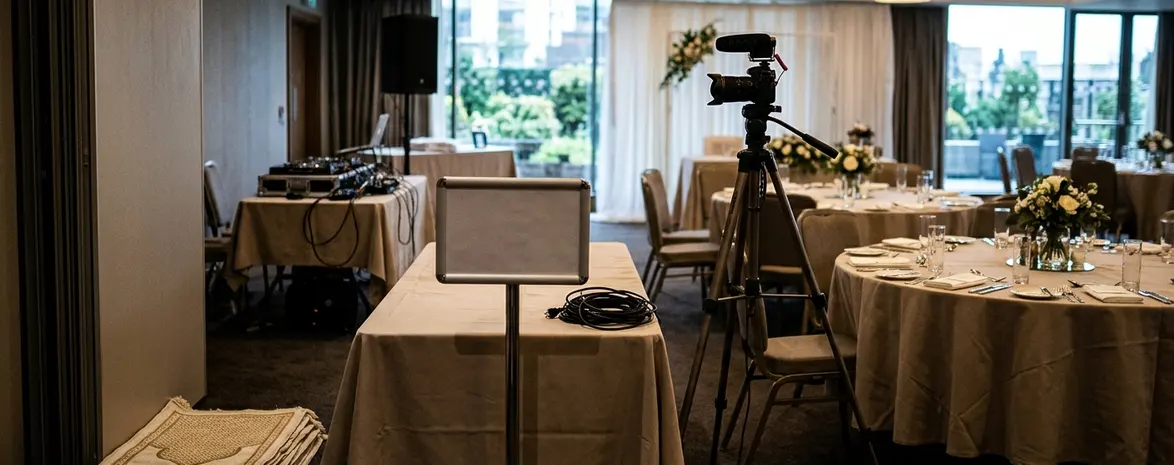
When the ballroom doors open for the banquet, you will step into a celebratory environment free of alcohol and pork. Instead of a champagne toast, tables feature crystal pitchers of mint and pomegranate mocktails, endless pours of spiced or mint tea, and tiered platters of saffron rice, slow-cooked halal meats, and regional delicacies. When passing platters or eating directly with your hands—such as tearing warm flatbread—custom favors using your right hand.
Smartphone Rules in Segregated Seating
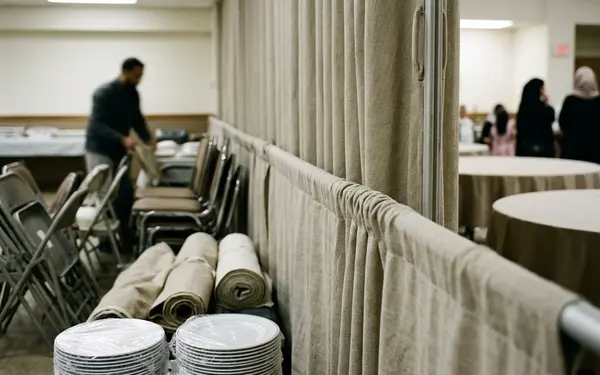
While mixed-gender receptions allow standard wedding photography, some families host fully segregated celebrations where men and women dine in separate halls or behind a full room divider. Inside the women-only hall, female guests remove their hijabs and outer abayas to showcase intricate hair styling and evening couture.
In these fully segregated women-only banquet halls, smartphone cameras are strictly prohibited from the moment the bridal procession (Zaffa) concludes until the groom's announced entrance, close to 30 to 60 minutes before the end of the night. Never take a selfie or table photo in a partitioned women's section without explicit permission from the hosts and every woman in the frame. When the MC announces that the groom and male relatives are preparing to enter the women's side for cake cutting and family portraits, you will see women re-drape their scarves and wraps—signaling that the strict camera ban is lifting for the stage photos.
Choosing your Gift and Connecting with the Couple's Families
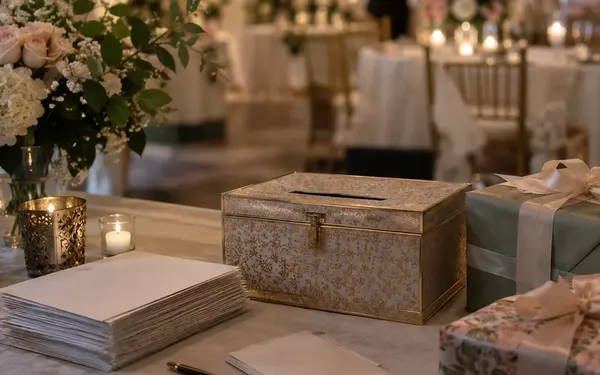
When selecting a wedding gift, gift etiquette favors helping the newlyweds establish their household without dietary guesswork. Guests who shop for boxed gourmet hampers must carefully inspect ingredient labels to eliminate hidden animal gelatin, vanilla extract containing alcohol, or wine-reduction sauces. To avoid accidental dietary missteps, seasoned guests opt for crisp banknotes placed inside a decorative, metallic-stamped envelope (often called a Salami or Eidi envelope). If you are attending a South Asian Muslim wedding, adding a single $1 coin or bill to round figures—gifting $101, $151, or $251—honors a beloved regional custom symbolizing ongoing prosperity and continuity. You can hand the sealed envelope directly to the couple's parents or drop it into the collection box near the stage.
Before you head to your car at the end of the night, budget 10 to 15 minutes for the farewell sequence. In Muslim cultures, the parents of both the bride and the groom view themselves as the primary co-hosts of the celebration. Slipping out the side door after dessert misses a vital touchpoint; etiquette requires seeking out and thanking both sets of parents for their hospitality before exiting the venue.
As you look at the invitation in your hand and prepare your envelope and attire, will you choose to greet the couple's parents at the door with a simple "Mabrook" or practice the full "Barakallahu lakuma" blessing to open your conversation?