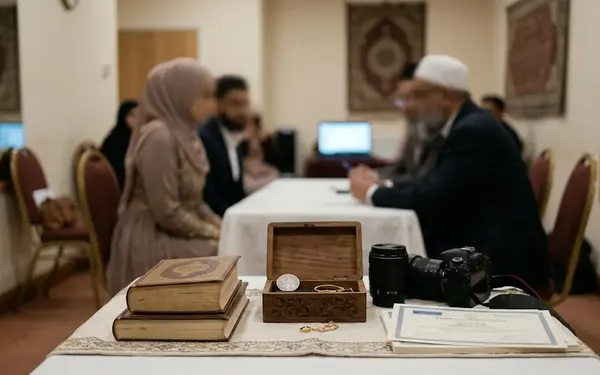
Why Negotiated Terms Belong in a Nikah Contract
A bride’s request to remain near her family has a long history in Islamic marriage law. Early jurists examined such stipulations, known as shurut, by asking whether the requested condition preserved the foundational purpose of marriage. Negotiating household arrangements before giving consent belongs within that classical discussion.
That history matters when someone at the planning table asks, “Why add conditions at all?” A promise about education, housing, or relocation can shape daily married life. Writing it down gives both spouses a shared reference before expectations become competing memories.
As marriage registration moved toward standardized administrative documents, pre-printed certificates compressed the space available for individually negotiated terms. A short special-conditions field encourages short answers, even when the couple needs a fuller agreement. The form can quietly become the agenda.
Start with the agreement you need, then decide how to document it. Where the form offers little room, prepare a clearly identified addendum and refer to it in the main contract. Customizing the document continues a recognizable Islamic legal practice: discussing meaningful conditions before the marriage begins.
How the Sunni Schools Treat Marriage Conditions
A written promise and an enforceable religious condition are different drafting questions. Before choosing wording, establish which legal approach your officiant will apply and what remedy follows a breach.
The Hanbali school gives broad effect to agreed conditions that respect Islamic prohibitions and the essential purpose of marriage. A condition against relocation or taking another wife can give the wife grounds to seek faskh, a judicial dissolution, if her husband breaches it.
Classical Hanafi and Shafi‘i approaches generally treat non-standard restrictions on otherwise permissible conduct more narrowly: the condition may be invalid while the marriage remains valid. Maliki treatment also places restrictions on such stipulations, with distinctions concerning the promise and its attached consequences. Conditional divorce mechanisms can change the analysis. These are school-level starting points; the wording and remedy attached to a particular condition shape its treatment.
The central boundary is straightforward: a clause cannot authorize something prohibited, prohibit something permissible as a general religious rule, or cancel fundamental marital obligations. A recognized monogamy condition, for example, establishes a contractual consequence for that marriage rather than declaring polygyny religiously forbidden.
Give Each Promise a Remedy
Ask the officiant to distinguish three things: the obligation, the event that breaches it, and the route to a remedy. “We agree to stay in this city” leaves important questions unanswered. Who must agree to a move? What counts as relocation? What happens if one spouse proceeds alone?
Because civil enforcement of religious marriage terms depends on local law and execution requirements, have a local family-law lawyer assess which terms need a separate, compliant prenuptial agreement before signing.
Turn Education, Employment, and Housing Plans into Clauses
Begin with the calendar already shaping your lives: a degree in progress, a professional licensing pathway, a job tied to a particular city. Then discuss the household arrangements those commitments require. This keeps the conversation concrete.

The following examples are discussion drafts for premarital counseling. Replace broad promises with named commitments, agreed responsibilities, and a defined remedy.
Protect a Named Educational or Career Commitment
“The spouses agree that the Wife may complete [named qualification] at [institution] and continue [identified employment or professional training]. They will agree in writing before changing their residence or household arrangements in a way that prevents these commitments.”
Name the course or employment arrangement rather than relying on “support her ambitions.” Discuss tuition, travel, working hours, and household responsibilities separately. Permission to continue a degree leaves the question of who pays for it unanswered.
Define the City and the Home
“The spouses will establish their marital home in [city]. Any permanent relocation outside [defined area] requires their mutual written agreement.”
“The Wife shall be provided an independent, private residence with a separate entrance and kitchen facilities, distinct from the residences of either party’s parents or extended relatives.”
Housing language deserves a slow conversation. A private bedroom in a shared family home differs substantially from an independent residence. Agree on the arrangement while everyone can discuss it calmly, and address temporary family visits separately from permanent co-residence.
Make Mahr, Money, and Monogamy Terms Precise
Financial clarity starts with an inventory: existing debts, ongoing obligations, account ownership, and the expenses each spouse expects to meet. Record whether accounts will remain separate or include a joint household account, then state how that account will be funded. Keep these arrangements distinct from the wife’s mahr entitlement.
Choose the Deferred Mahr’s Unit and Payment Trigger
For deferred mahr, or mu’akhkhar, specify the amount, what it is measured in, and when it becomes payable. “Payable later” leaves the central obligation unfinished.
A fixed fiat-currency amount preserves a nominal sum. Its purchasing power can fall as prices rise. A specified weight of 24-karat gold instead fixes a gold quantity, whose cash equivalent changes with the gold price. That approach introduces price movement rather than preserving a constant cash value.
If the agreement allows cash settlement of gold-denominated mahr, identify the valuation date and an agreed price reference. If the couple chooses an inflation-linked currency amount, identify the index, base date, and adjustment method. A fixed calendar payment schedule offers another way to make payment concrete rather than leaving the entire sum until death or divorce.
State the Consequence of a Monogamy Breach
Under the classical Hanbali approach, a bride can stipulate that her husband will not marry another wife. A breach gives her the right to seek dissolution. Draft the condition together with its remedy; a sentence expressing a preference for monogamy does less work than a defined contractual commitment.
Write Delegated Divorce as an Operative Clause
Tafwid al-Talaq means delegation of the authority to pronounce divorce. The husband grants the wife authority to exercise that right within the terms specified in the agreement. A conditional delegation can connect that authority to an agreed event, such as breach of a monogamy condition.
The clause should identify the triggering event, how the wife exercises the delegation, and how the exercise is documented. It should also expressly preserve outstanding mahr and the financial entitlements covered by the agreement. This creates a different route from asking a religious adjudicator for fault-based dissolution or negotiating a release in exchange for surrendering mahr.
Keep the mechanisms distinct: a promise establishes conduct; a dissolution remedy addresses breach; delegated divorce grants authority that must be exercised under its stated terms.
Bring Your Imam a Draft You Both Understand
Present custom clauses as shared marriage planning. A calm introduction helps: “We have written down the arrangements we both want, and we would like to review their religious wording before the ceremony.”
- Agree privately first. Discuss each clause together in premarital counseling. Mark unresolved points rather than presenting them to relatives as settled decisions.
- Explain the practical purpose to both families. Connect the education clause to the existing course, the housing clause to the intended home, and the mahr schedule to a clear payment obligation.
- Send the complete draft ahead. Include the main contract, proposed addendum, and questions about the applicable school, remedies, and delegated divorce wording.
- Confirm the signing process. Ask how the addendum will be incorporated and signed by the couple, witnesses, and officiant. Prepare matching copies so everyone signs the same agreed text.
Schedule a private forty-five-minute meeting with your officiating imam at least sixty days before the ceremony; send your written draft with the invitation and ask him to confirm that he will sign and witness the customized contract.